


Euchre Classic Card Game
FIOGONIA LIMITED
I like card games that are easy to pick up but still punish careless decisions, and Euchre Classic Card Game fits that description better than its plain presentation might suggest. This is a free card game from FIOGONIA LIMITED built around Euchre, with both online and offline play available. My overall view is simple: it is a good choice for someone who already enjoys trick-taking games or wants a compact way to practice Euchre, but it is less convincing for players looking for a large social platform, a deep collection of modes, or a highly polished visual experience.
The appeal comes from the structure of Euchre itself. A hand can turn on the choice of trump, the timing of a high card, or the decision to let a partner’s trick stand instead of taking it yourself. That gives each round more thought than a purely luck-driven card game, while keeping the rules manageable enough for short sessions. The best reason to try it is the balance between quick rounds and meaningful decisions.
How the Euchre experience feels in everyday play
When I open Euchre Classic Card Game, I am not expecting a campaign, a story, or a huge menu of distractions. The focus is the card table. That narrow purpose works in its favor when I have a few spare minutes and want something more engaging than an automatic solitaire game. A short break, a quiet evening, or a trip without a reliable connection are all situations where this kind of focused card game makes sense.
The basic rhythm is familiar to Euchre players: assess the hand, decide whether the proposed trump is worth accepting, and then play each trick with an eye on both the current cards and the likely distribution of the remaining deck. The rules are not difficult to understand, but good play depends on remembering what has already appeared. That makes the game useful as a light mental exercise without turning every session into a serious study project.
The offline option is particularly practical. I can imagine using it during a commute, while waiting for an appointment, or at home when I do not want notifications and online interaction competing for attention. Offline play also makes the app more dependable as a private practice table. I can experiment with calling trump or leading a particular suit without worrying about slowing down another person.
Related News






Online play changes the mood. Against other people, a familiar hand becomes less predictable because human players do not always follow the safest line. That unpredictability is valuable once the basic rules feel comfortable. It also exposes a weakness of any digital Euchre table: the quality of the match depends heavily on the people involved. A patient, thoughtful opponent can make a close game memorable, while a rushed or careless table can make the same rules feel flat.
The game is rated for Everyone, which matches the straightforward nature of the subject matter. I would be comfortable suggesting it to a family member who wants a traditional card game rather than an action-heavy mobile title. Still, younger or completely new players may need a little time to understand why the right move is not always the card that wins the current trick. Euchre has its own logic, and the app works best when the player is willing to learn that logic instead of treating every hand as a simple high-card contest.
Why the decision-making is more interesting than it first appears
The most important skill is not merely spotting the strongest card. It is judging whether the hand can support a particular trump choice and whether the partnership can reach the target number of tricks. A hand with a powerful trump card may still be awkward if the side cards are weak. Conversely, a modest-looking hand can become useful when the right suit is called and the lead passes to the player at the right moment.
Gallery
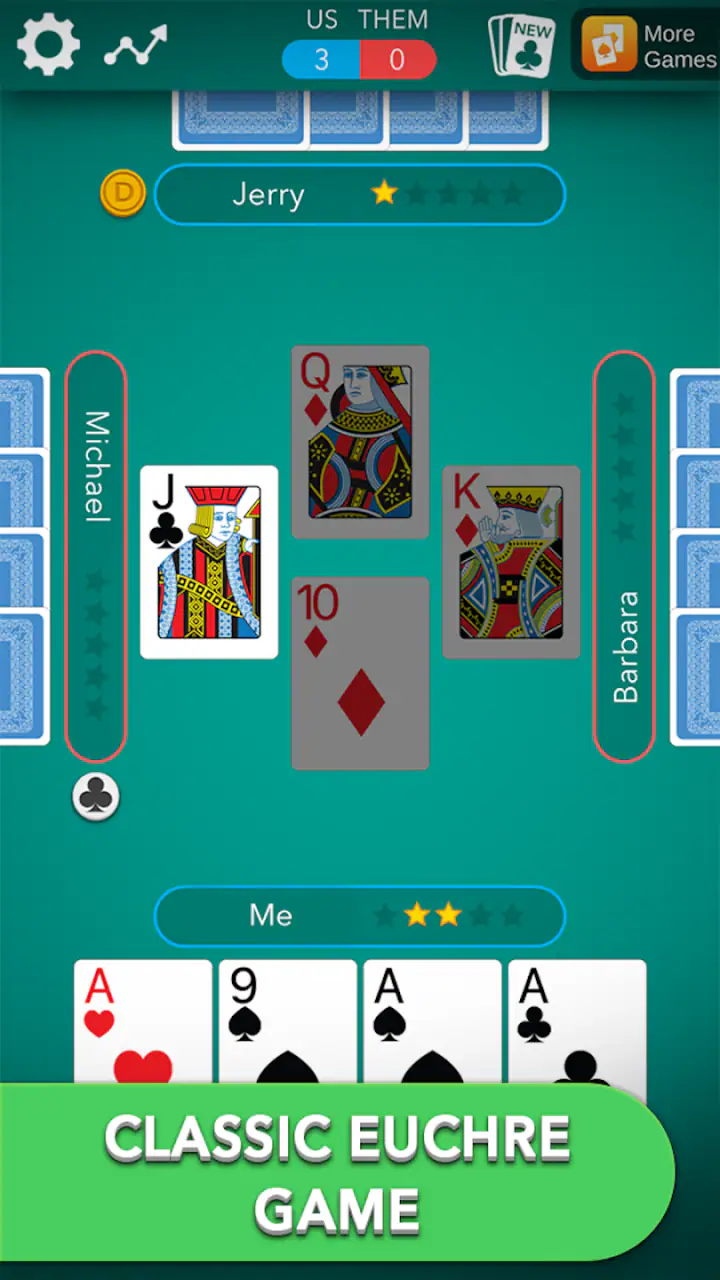
I find it helpful to separate three questions before playing the first card. What cards are likely to win immediately? Which cards can create a later advantage? And what information will my play give to the other side? That last question is easy to overlook in a casual mobile game, but it is where Euchre becomes more than a sequence of random deals.
One practical habit is to track the important cards rather than trying to remember every card in perfect detail. If the strongest trump cards have already been played, a lower trump may suddenly be safe. If a suit has been led and an opponent fails to follow it, that player may have an opportunity to use trump later. This kind of selective memory keeps the game approachable while still rewarding attention.
Another useful adjustment is to treat the first trick as information gathering when the hand does not clearly demand an aggressive play. Leading a side suit can reveal who is short in that suit, while leading trump can remove dangerous cards before they become a problem. Neither approach is automatically correct. The right choice depends on the strength of the hand, the likely partner support, and the score situation.
That scoring context matters more than a new player may expect. When a team is close to winning, a conservative line can be better than chasing an impressive sweep. When behind, taking a calculated risk may be necessary. I appreciate that this gives the app a small but genuine learning curve: the same cards can deserve different treatment depending on the state of the game.
Offline practice is more useful than a simple fallback
I would not treat offline play as merely a backup for when the connection fails. It can be used deliberately as a training routine. A new player can focus on recognizing trump relationships, noticing when a suit becomes dangerous, and learning how to protect a partner’s likely winner. Someone returning to Euchre after years away can use the quiet pace to rebuild confidence before joining online tables.
There is also a useful difference between practicing a rule and practicing judgment. Rules can be learned from an explanation, but judgment improves through repeated hands. Offline rounds let me test a decision, see how the trick develops, and think about what I missed. That makes the mode valuable even when the computer does not feel as unpredictable or socially interesting as a real opponent.
The trade-off is that offline opponents cannot reproduce every human habit. A computer-controlled table may provide consistency, but it will not necessarily bluff, hesitate, or make the same unusual choices as a person. For that reason, I see offline play as preparation and relaxation, while online play is the better test once I want stronger variety.
Where the app shows its limits
The focused design can also feel restrictive. Players who want several card games in one download will probably prefer a broader card collection. This title is centered on Euchre, so its value depends on whether that particular game holds your attention. If you are hoping for poker tournaments, solitaire variations, collectible cards, or a progression-heavy system, this is not the right destination.
The presentation is functional rather than the main attraction. That is not a serious problem for a traditional card game, because readable cards and clear turn flow matter more than elaborate effects. However, anyone choosing mobile games primarily for visual polish may find the experience ordinary. I would rather have an uncluttered table than distracting animation, but the app does not try to compete with premium-looking board-game adaptations.
Online play also requires the right expectations. It adds human variety, but it does not automatically make every session better. A player who dislikes waiting for others, dealing with uneven skill levels, or adapting to unfamiliar table habits may prefer the control of offline rounds. In my experience, the best approach is to use offline play for dependable short sessions and online play when I am in the mood for a less predictable match.
The free entry point is welcome, though in-app purchases range from $4.99 to $29.99 per item. That means I would look carefully at what is offered before spending money. The free version is the sensible starting point because the central question is not whether Euchre is interesting in theory, but whether this particular table experience suits your habits. I would only consider an optional purchase after playing enough rounds to know that I will return regularly.
Device compatibility is also worth checking before installing. The game supports Android 7.0 and later, which covers many older devices but not every handset still in use. On supported phones, the modest requirements should make it a reasonable candidate for people who do not want a demanding 3D game taking over their storage or battery routine. I would still keep expectations realistic: this is a card table, not a showcase for phone hardware.
Who will get the most from it
This is a strong fit for an existing Euchre player who wants a portable table. It is also suitable for someone who enjoys bridge-like decision-making but wants shorter, less formal rounds. The game gives enough room to think about partnership, trump control, and card memory without requiring the time commitment of a longer strategy title.
It can work well for casual learners too, especially those who have a friend or relative who already knows Euchre. A new player can practice alone, then use online play to become comfortable with real opponents. I would recommend starting with conservative calls and paying attention to why a trick was won or lost rather than trying to imitate aggressive play immediately.
Families may appreciate the Everyone rating and the absence of a need for a large setup. Someone who used to play physical Euchre at gatherings can pick up the app for a familiar experience when the usual group is unavailable. The important caveat is that digital play cannot fully replace sitting around a table with people you know. The app reproduces the game, not the conversation, gestures, or shared routine around it.
I would be more hesitant to recommend it to a player who needs constant novelty. There is no reason to expect the core appeal to change dramatically from one session to the next: the variety comes from the deals, decisions, and opponents. That is enough for a dedicated card player, but not necessarily for someone who loses interest unless a game keeps unlocking new content.
It is also not my first suggestion for someone who wants a completely luck-free strategy experience. Euchre rewards skill, but the deal still influences the possibilities. A thoughtful player can improve the odds and make better decisions, yet cannot control every hand. That mix is part of the charm for me, but players seeking total control may prefer a puzzle or abstract strategy game.
How it compares with physical cards and broader alternatives
Compared with a physical deck, the app removes setup and scoring friction. There is no need to find three other people, shuffle, deal, or keep track of every point manually. That convenience is its clearest advantage. It is especially useful when I want to play immediately or when no one nearby knows the rules well enough to start a table.
The physical version remains better for social atmosphere and flexible house rules. Around a real table, players can explain decisions naturally and adjust the pace to suit beginners. The app is more consistent, but that consistency can feel less personal. I see the two formats as complementary rather than competing: the mobile version keeps the habit alive between gatherings.
Compared with a general solitaire app, this game asks for more planning and partnership awareness. Solitaire is often ideal when I want a solitary puzzle with no opponent to consider. Euchre is better when I want decisions shaped by another team and by the possibility that my partner’s cards are stronger or weaker than expected. The choice depends on whether I want private problem-solving or a trick-taking contest.
Compared with a large multiplayer card platform, the narrower focus may be an advantage for Euchre fans. I do not have to sift through unrelated modes to reach the game I want. The disadvantage is obvious too: players who like moving between many card formats may find the selection limited. This app earns its place through concentration, not variety.
What I would do before committing to it
I would begin with several offline rounds, even if I already know the rules. That gives me a chance to judge the card layout, pace, and decision flow without the pressure of an online table. During those rounds, I would pay attention to whether the controls make it easy to distinguish trump from side suits and whether the scoring remains clear after each hand.
Next, I would try online play with modest expectations. The purpose is not to prove skill immediately, but to see whether the multiplayer rhythm suits me. If I enjoy adapting to different opponents, the game becomes more rewarding. If I find the online pace frustrating, the offline mode can still justify keeping it as a personal practice game.
I would also avoid paying for anything until I understood the free experience. Because the app costs nothing to start, there is little reason to rush that decision. Play it during the exact situations in which you expect to use it: a short break, a disconnected journey, or a quiet evening. That real-world test will tell you more than a quick first impression.
FIOGONIA LIMITED has kept the product centered on the classic card format, and the current version is 1.6.1. The app has been available since March 16, 2021, and its audience has grown beyond a small experiment, with over 500 thousand installs. Its average rating is 4.1 from around 8.5 thousand ratings, alongside roughly 3.1 thousand written reviews. Those figures suggest a reasonably established player base, but I would still judge it by whether its focused approach matches my own preference for Euchre.
My final recommendation is positive but specific. Euchre Classic Card Game is worth installing if you want a free, portable way to play Euchre online and offline, especially if you value quick rounds and decisions that reward memory, timing, and partnership thinking. I would skip it if you need a broad library of card games, a highly cinematic presentation, or a purely social replacement for a real table.
For me, the game succeeds because it respects the underlying card game instead of burying it under unnecessary extras. Its limitations are the same qualities that make it appealing: the scope is narrow, the visuals are secondary, and the long-term variety depends on how much I enjoy repeating and improving at Euchre. If that sounds like a strength rather than a warning, this is a sensible card game to keep on an Android device.
FAQs for Euchre Classic Card Game
What is Euchre Classic Card Game?
Euchre Classic Card Game is a digital version of the traditional trick-taking card game, usually played by four players in two partnerships. The app lets you practice bidding, choosing trump, and playing tricks against computer opponents, with rules designed to match the familiar tabletop experience. It is suitable for both newcomers and experienced Euchre players.
Can beginners learn how to play Euchre with this app?
Yes. Euchre Classic Card Game can be a useful starting point for beginners because the gameplay is divided into clear rounds and familiar card actions. New players can learn how trump works, how bowers affect card strength, and how teams score points by observing the computer’s moves. However, some prior knowledge of basic card-game terms may make the first matches easier.
Can I play Euchre Classic Card Game offline?
The game is generally designed to support solo play against computer-controlled opponents, which makes it convenient when you do not have an internet connection. Offline availability can depend on the specific version, device, and features being used. Online services, advertisements, updates, or certain multiplayer options may still require connectivity, so check the store listing before downloading.
Does Euchre Classic Card Game include multiplayer or online play?
The main appeal of many Euchre apps is the ability to play quick matches against artificial intelligence, while multiplayer availability varies between versions and platforms. Some editions may offer local or online competition, whereas others focus entirely on solo play. Before installing, review the current app description to confirm whether online rooms, friend invites, or local multiplayer are included.
Is Euchre Classic Card Game free to download and safe to use?
Euchre Classic Card Game may be available as a free download, although the exact business model can differ between Android and iOS versions. Free editions can include advertising, optional purchases, or premium features. Downloading through the official Google Play Store or Apple App Store is the safest option. Always review requested permissions, developer information, ratings, and recent user feedback before installing.
Pros
- Simple rules make it easy for new players to learn quickly.
- Offline play lets you enjoy matches without an internet connection.
- Short rounds fit well into quick gaming sessions.
- Adjustable difficulty provides a challenge for different skill levels.
- Clean card layout keeps suits
- tricks
- and scores easy to follow.
Cons
- Limited variation may feel repetitive after extended play.
- Computer opponents can sometimes make predictable moves.
- Some features may be restricted behind ads or in-app purchases.
- The game may lack deep customization for experienced players.
- Online options
- if available
- may depend on an active player base.


